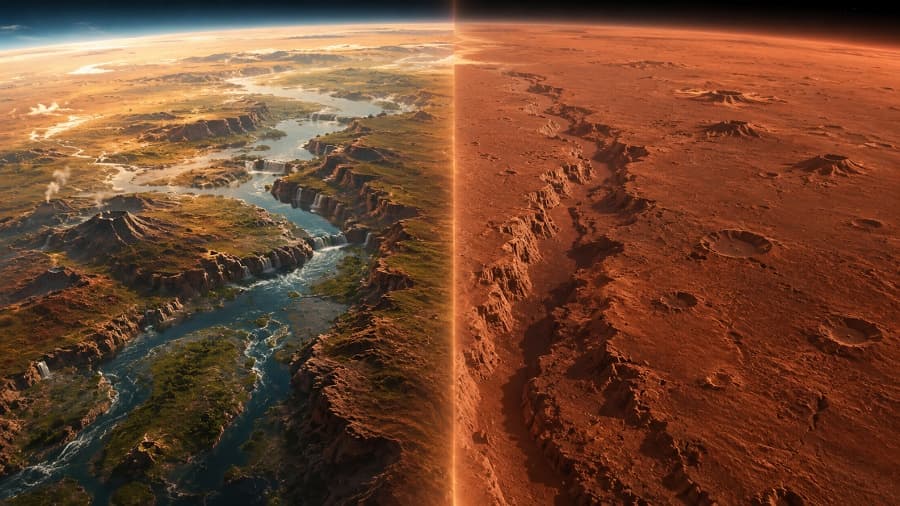
Ancient Mega-Floods May Have Once Torn Across Mars, ESA Images Reveal
Today’s Mars is a dry, frozen, and lifeless world. Across its vast red wasteland remain enormous scars that are impossible to ignore — marks that look as though the planet’s surface was once torn apart by unimaginable forces, or carved open by ancient floods. These colossal traces stretch thousands of kilometers across Mars. Among the most striking is the “Shalbatana Vallis,” located near the Martian equator.
According to a report by Science Daily, observation images released by the European Space Agency’s Mars Express spacecraft show that this massive canyon extends roughly 1,300 kilometers, nearly the length of Italy itself. Seen from above, it resembles a deep wound etched into the Martian surface, winding across barren plains and fractured terrain. Scientists believe the canyon formed around 3.5 billion years ago, when huge quantities of underground water suddenly burst through the surface, unleashing catastrophic floods across Mars. Those raging torrents ultimately carved river channels hundreds of meters deep.
The latest Mars Express observations focus on the northern section of the canyon. The images clearly show a main valley about 10 kilometers wide and 500 meters deep, stretching northward from the lower-left portion of the image before eventually flowing into lower-lying plains. Although no water remains there today, the landscape still preserves the scars left behind by those ancient floods.
Some regions display bizarre terrain filled with shattered rocks, broken hills, and chaotic highlands, as though the ground itself suddenly collapsed. The European Space Agency noted that this type of landscape may be linked to the melting of underground ice deposits. As deeply buried ice disappeared, the surface above likely caved in, creating the fractured and chaotic scenery seen today.
Many signs of volcanic activity
In addition to evidence of floods and collapse, the area surrounding Shalbatana Vallis also contains many signs of ancient volcanic activity, Science Daily reported. Within the rugged valleys are large bluish-black deposits that researchers believe may be remnants of volcanic ash later scattered by powerful Martian winds. Some plains also feature wrinkle ridges formed by flowing lava, resembling waves frozen and compressed into the ground.
SIGN UP FOR OUR FREE NEWSLETTER
You are now signed up for our newsletter
Check your email to complete sign up
Scattered throughout the region are countless impact craters. Some still retain sharply defined rims, while others have been gradually buried and eroded over time. Around certain craters, layers of debris ejected during asteroid impacts remain visible, like ancient wounds preserved on the surface of Mars.
Perhaps even more intriguing is the “Chryse Planitia,” the lowland region into which Shalbatana Vallis ultimately flows. It is one of the lowest areas on Mars and the endpoint of many massive outflow channels. For this reason, some scientists have long speculated that during Mars’ warmer and wetter ancient past, this basin may once have collected enormous quantities of water — perhaps even forming a vast ocean. If these theories are correct, the dry and desolate Mars of today may once have looked entirely different.
The European Space Agency noted that since its launch in 2003, Mars Express has spent more than 20 years exploring Mars. During that time, the spacecraft has continuously mapped the planet’s surface in three dimensions, gradually revealing the dramatic changes this red world once experienced.
Between the giant canyons, dried riverbeds, and collapsed landscapes, Mars seems to preserve memories of an ancient age. The immense marks carved into its surface continue to raise a haunting question: Did this cold and silent planet once truly possess oceans and a world of flowing water?
By Xing Yue, Vision Times