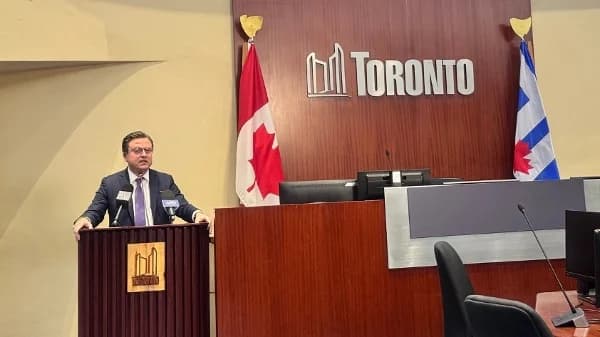
Jan Jekielek Sounds Alarm on CCP Influence, Forced Organ Harvesting at Toronto Event
TORONTO, Canada — Just days before Chinese Foreign Minister Wang Yi’s planned visit to Canada, New York Times bestselling author and investigative journalist Jan Jekielek held a book launch on May 27 at Toronto City Hall for his new book, Killed to Order.
The evening began with a screening of the documentary State Organs and concluded with a discussion about forced organ harvesting in China, foreign interference, and the challenges facing democratic societies.
The event drew a large audience, many of whom participated in a lengthy Q&A session that exposed the reality of systematic organ harvesting in China. Several attendees said the documentary unveiled realities they had never previously encountered and pledged to help raise awareness about the atrocities.
RELATED: Congressional Commission Holds Hearing on Forced Organ Harvesting in China as Trump Meets Xi
Disturbing amounts of evidence
When asked what evidence most shocked him during his years of investigating forced organ harvesting, Jekielek pointed to a landmark 2022 study published in the American Journal of Transplantation. The researchers reviewed thousands of Chinese transplant papers and identified 71 cases that appeared to describe organ procurement procedures in which the removal of organs may have been the direct cause of the donor’s death.
SIGN UP FOR OUR FREE NEWSLETTER
You are now signed up for our newsletter
Check your email to complete sign up
“These details were openly written into scientific research methods and publicly published,” Jekielek said. “That tells us something profound about how normalized this kind of ‘on-demand murder’ had become. The people involved did not even realize that what they were describing should never appear in a legitimate scientific paper.”
Jekielek also recalled how he first became involved in the issue in 2006 after speaking with two independent whistleblowers. One was Annie, a former hospital employee in China whose husband allegedly removed corneas from approximately 2,000 living organ donors. The other was Israeli transplant surgeon Dr. Jacob Lavee, whose patient told him he had already scheduled a heart transplant operation in China two weeks in advance.
“You can’t schedule a heart transplant two weeks ahead unless someone is going to be killed on demand,” Jekielek said. “That was the moment I realized this was happening on a large scale.”
Why the world looked away
Jekielek believes there are three main reasons the issue failed to attract broader international attention for so many years.
First, many people found the allegations difficult to believe. “It sounds like something from a science-fiction movie,” he said. “People have trouble accepting that it could be real.” He noted that attitudes began shifting after the COVID-19 pandemic, when many people witnessed videos of Chinese authorities enforcing strict lockdowns.
Second, he pointed to what he described as a “devil’s bargain” within international media. News organizations seeking access to China often avoid politically sensitive topics, including Falun Gong, Taiwan, Xinjiang, and forced organ harvesting, out of concern that reporting could jeopardize their ability to operate in the country.
Third, he argued that the Chinese Communist Party (CCP) creates incentives for outside actors to avoid confronting uncomfortable realities. Quoting author Upton Sinclair, Jekielek said: “It is difficult to get a man to understand something when his salary depends upon his not understanding it.”
Concerns extend beyond Falun Gong
During the event, one audience member from China described witnessing unexplained disappearances of young people in her father’s hometown. She said many residents privately suspected what had happened but were afraid to discuss it openly.
Jekielek responded by noting that atrocities rarely remain confined to a single group. “The CCP initially built this organ harvesting system using Falun Gong practitioners as its primary target,” he said. “After 2015 and 2016, Uyghur Muslims were increasingly drawn into the system as well.”
He added that reports involving disappearances of young people and growing dehumanizing rhetoric directed at religious communities are deeply concerning. “Dehumanization is often a precursor to large-scale atrocities,” he warned.
Falun Gong, also known as a Falun Dafa, is an ancient spiritual discipline rooted in the principles of Truthfulness, Compassion, and Tolerance. Despite being peaceful in nature, the CCP launched a brutal campaign to eradicate the practice in 1999. Since then, many practitioners have reported widespread detention, forced labor, and medical testing consistent with organ matching procedures.
Breaking through China’s controls
Asked what ordinary citizens can do to help, Jekielek emphasized the importance of breaking through China’s information blockade. “China’s internet is not really the internet,” he said. “It is closed and heavily filtered.” He noted that millions of Chinese citizens already use circumvention tools to access uncensored information, including independent reporting from overseas Chinese-language media.
“If free governments were willing to support efforts that help Chinese people learn the truth, it could be one of the most powerful ways to challenge this system,” he said, adding, “Most Chinese people do not support forced organ harvesting. They simply do not know it is happening.”
Jekielek also highlighted recent legislative efforts in the United States that would impose sanctions related to forced organ harvesting, arguing that targeted penalties can create meaningful pressure.
Growing CCP influence in Canada
Jekielek reserved some of his strongest comments for Canada’s relationship with Beijing. “You are dealing with a regime that views these kinds of extreme crimes as normal,” he said. “If you don’t understand that, you will make serious mistakes because you will treat it like a normal government.”
He argued that Beijing approaches international relations as a zero-sum competition. “In their view, ‘win-win’ means I win twice,” he said. Jekielek also warned about the activities of the CCP’s United Front Work, which he described as an organization dedicated to influencing political systems and civil society groups both inside and outside China.
As the evening concluded, attendees reflected on the importance of public awareness and civic engagement. Many expressed hope that continued education, grassroots advocacy, and open discussion could help expose human rights abuses that often remain hidden from public view.