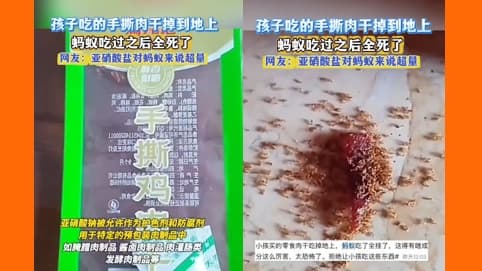
Viral Video Shows Chinese Children’s Snack Killing Ants Within Minutes
A child in Hainan dropped some crumbs from a packet of shredded dried meat, a cheap, widely sold snack marketed to young children. Ants found the crumbs first. Within minutes, every ant that had eaten from the pile was dead. The parent filmed the scene and posted it to social media.
The snack’s ingredient list identified two additives: ethyl maltol, a flavor enhancer that produces a sweet, caramel-like aroma, and sodium nitrite, a preservative used in processed meat products. Ethyl maltol drew the ants in. Sodium nitrite killed them by blocking the oxygen-carrying capacity of their cells, causing them to suffocate. Food safety analysts who examined the footage pointed out that the combined mechanism is functionally identical to commercial insect bait. Ants died so quickly because their small body size and rapid metabolism leave them no buffer against even trace doses of compounds that suppress cellular respiration.
Sodium nitrite: legal in meat, carcinogenic under heat
Sodium nitrite is a permitted food additive in China and in most countries. Manufacturers use it to inhibit the growth of Clostridium botulinum, the bacterium responsible for botulism, and to extend shelf life. It also keeps processed meat looking pink rather than grey. The problem is what happens at high temperatures or in acidic environments: sodium nitrite can react with amines naturally present in protein-rich foods to form nitrosamines, a class of compounds classified as probable human carcinogens.
Experts quoted in Chinese media coverage of the Hainan video warned that snacks with this level of additive loading are unsuitable as a regular dietary staple for children. Children’s livers and kidneys, still developing, metabolize and eliminate additives more slowly than adults. Repeated high-frequency consumption of heavily processed snacks allows additives to accumulate faster than developing organs can clear them, raising the risk of harm to growth and long-term organ function.
One user wrote that the product had given them chills and that they would not eat it again. Another noted the irony: they had failed to kill ants with pesticide ordered online, only to find that a children’s snack had done the job within minutes. A third: if ants die from eating it, people who eat it regularly will suffer the same fate, just more slowly.
孩子零食手撕肉毒死蚂蚁引恐慌。5 月 17 日,海南家长分享了一段视频:孩子吃的手撕肉干掉在地上,没过多久,爬去吃的蚂蚁全都死了。这样的东西孩子吃下去安全吗? pic.twitter.com/q2Ope3WTEu— 新闻调查 (@xinwendiaocha) May 20, 2026
孩子零食手撕肉毒死蚂蚁引恐慌。5 月 17 日,海南家长分享了一段视频:孩子吃的手撕肉干掉在地上,没过多久,爬去吃的蚂蚁全都死了。这样的东西孩子吃下去安全吗? pic.twitter.com/q2Ope3WTEu
SIGN UP FOR OUR FREE NEWSLETTER
You are now signed up for our newsletter
Check your email to complete sign up
Fujian bayberry depots caught soaking fruit in banned preservatives
Weeks before the Hainan video, reporting by the state-run newspapers Yangcheng Evening News and Xinmin Evening News documented a separate scandal in Zhangzhou, Fujian province. Multiple purchasing depots handling bayberry, a small dark-red fruit that ripens across southern China every May and moves in bulk to urban markets, were found to be soaking the harvest in dehydroacetic acid sodium, a synthetic preservative banned in several countries for its effects on liver and kidney function, and coating it with unlabeled, ultra-sweet flavor additives whose packaging claimed a sweetness level 8,000 times that of table sugar. The additives carried no production date, no ingredient list, and no manufacturer information: unregistered, unlabeled, and untraceable under any regulatory framework.
A single depot is capable of shipping hundreds of kilograms of bayberry a day at the height of the season, with several thousand kilograms moving over the course of the harvest. The treated fruit moves primarily to wholesale markets and e-commerce platforms in Shanghai and Zhejiang province. Workers at the depots were candid with the journalists: they would not eat the fruit themselves. When inspectors arrived, the depots had a ready system: a few crates of untreated bayberries were kept on hand and marked in advance, inspectors received samples from those crates, and the rest continued to be processed as usual.
According to local reports, the unlabeled sweeteners likely contained saccharin sodium and cyclamate in excess quantities. Cyclamate, an artificial sweetener banned in the United States since 1969 over cancer concerns, carries risks of neurological damage with chronic exposure, including dizziness, headaches, and memory impairment. Adolescents, whose nervous systems and hormonal regulation are still forming, face disproportionate harm.
Pesticide sprayed onto vegetables at a Guizhou market stall
In March, a vendor in Luodian County, Guizhou province, was filmed spraying mosquito repellent directly onto vegetables and fruit on his stall. Multiple passersby watched. The video circulated widely.
Local market regulators responded that the weather had been hot, mosquitoes were numerous, and the vendor had bought an insecticide spray and applied it to his produce. Officials said they had educated the vendor after receiving a tip-off. Because it was a “first offense,” no fine was issued. The contaminated produce was destroyed.
Commenters said it was certainly not his first offense, only his first time being caught. Others predicted he would not be the last, and that next time he would simply be more careful about who was watching. A third observation circulated widely: no punishment had been issued because the whole market operates the same way. Separate footage, also circulating online, showed a pork vendor at a market stall reaching for a can of insecticide, spraying it across cuts of meat on display, then quickly concealing the can when customers approached.
China’s food safety failures follow the same pattern
In 2008, melamine was added to infant formula by multiple manufacturers to falsify protein readings; six babies died and nearly 300,000 fell ill. In the early 2010s, industrial waste oil recovered from restaurant grease traps and drainage ditches was reprocessed and sold as cooking oil, with a 2011 crackdown dismantling networks operating across fourteen provinces. In 2013, inspectors in Guangzhou found that nearly half the rice tested in the city contained cadmium levels exceeding national safety standards, with the contamination traced to Hunan province, where heavy metal pollution from mining had leached into agricultural soil for years. In 2018, Changchun Changsheng Biotechnology falsified production records for more than 250,000 rabies vaccine doses distributed to children across China.