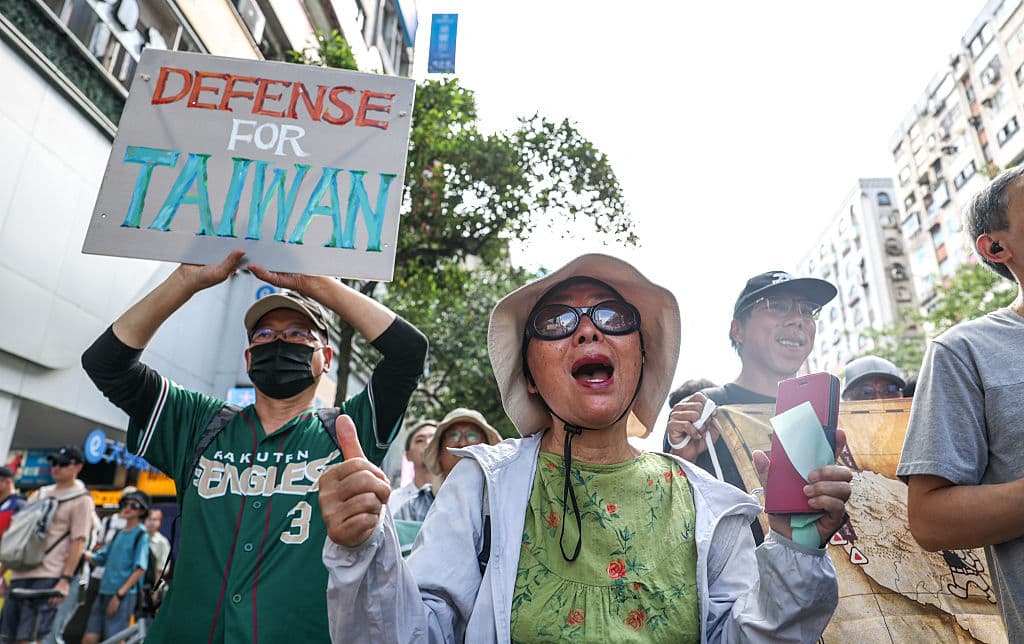
Over 8,000 Rally in Taipei to Demand Taiwan Strengthen Its Defense Budget
Taiwan’s civic groups delivered a pointed message to their legislators on Saturday: peace is not achieved by kneeling.
According to Liberty Times, more than 8,000 people marched through central Taipei on May 23 under the banner “Real Peace Requires Defense,” a rally organized by civil society organizations including the Taiwan Citizen Front, the Taiwan Economic Democracy Union, and the Tibet-Taiwan Human Rights Link. The march set off from the Zhongxiao Fuxing area and moved west along Zhongxiao East Road to Taipei 101, with crowds chanting “Real peace, real defense” and “Reject the one-China annexation trap.” Demonstrators held signs reading “No arms purchases, no future” and “Defense keeps the peace.”
The legislature passed a defense special budget of NT$780 billion (about US$24.7 billion), against an executive branch proposal of NT$1.25 trillion (about US$39.6 billion). The enacted budget removed programs spanning both near-term production capacity and longer-term indigenous development, including items the executive branch had proposed as core to Taiwan’s asymmetric warfare posture.
Legislature stripped drone, missile, and AI combat funding
The deleted line items prompted sharp criticism from technical experts at the rally. Taiwan Economic Democracy Union convener Lai Chung-chiang said the core problem was the removal of critical programs, not just the reduction in total spending, Taiwan News reported. The cut items included Strong Bow missile systems, uncrewed vehicles, additional ammunition stocks, AI-powered combat systems, and funding for domestic arms manufacturers. The enacted budget retained only purchases from the US government, eliminating the indigenous defense component entirely.
According to the Taipei Times, Koo Kwang-ming Foundation chairwoman Michelle Wang said Ukraine’s resistance against Russia had demonstrated that asymmetric warfare capabilities, particularly drones and uncrewed vehicles, are indispensable to a smaller country defending itself. The opposition parties had removed exactly those programs, she said.
SIGN UP FOR OUR FREE NEWSLETTER
You are now signed up for our newsletter
Check your email to complete sign up
Participants drew on Russia’s war against Ukraine to press the argument more broadly. The conflict had demonstrated, attendees said, that a country without sufficient defense resources cannot protect itself, and that lesson had brought them into the streets. Others said they opposed war but rejected the conclusion that reluctance to fight should mean reluctance to prepare for it.
Ruling and opposition parties clash over defense spending
The budget dispute exposed a fault line between Taiwan’s two major parties. Local media reported that Wang Ting-yu, a lawmaker from the ruling Democratic Progressive Party, accused the opposition of weakening Taiwan’s capacity to defend its people and territory through the budget cuts. The opposition Kuomintang’s legislator Weng Hsiao-ling offered a different framing: the Kuomintang supports indigenous defense development in principle, she said, but argues that parts of the defense industry have become too closely entangled with specific political factions, and that tighter oversight and scrutiny of the budget are therefore warranted.
The march organizers rejected that framing and called on the executive branch to introduce a second defense special act to restore the deleted programs.
A US$14 billion arms sale pause raises the stakes
The rally also absorbed anxiety about developments beyond Taiwan’s legislature. U.S. Acting Navy Secretary Hung Cao told a Senate hearing on May 22 that Washington had paused a US$14 billion arms package to Taiwan, saying the administration needed to ensure sufficient munitions for its military operations against Iran before proceeding with foreign military sales. Taiwan’s presidential office said it had not been formally notified of any change to the deal.
The march organizers invoked Tibet as a cautionary example: a territory that faced authoritarian annexation and, lacking the means to resist, lost control of its own future. According to the Taipei Times, human rights advocate Lee Ming-che said China had failed to honor commitments made to both Tibet and Hong Kong, and asked: if Beijing could not tolerate either, how could it possibly tolerate Taiwan, with its larger economy, democratic institutions, and armed forces?
By Li Ming, Vision Times