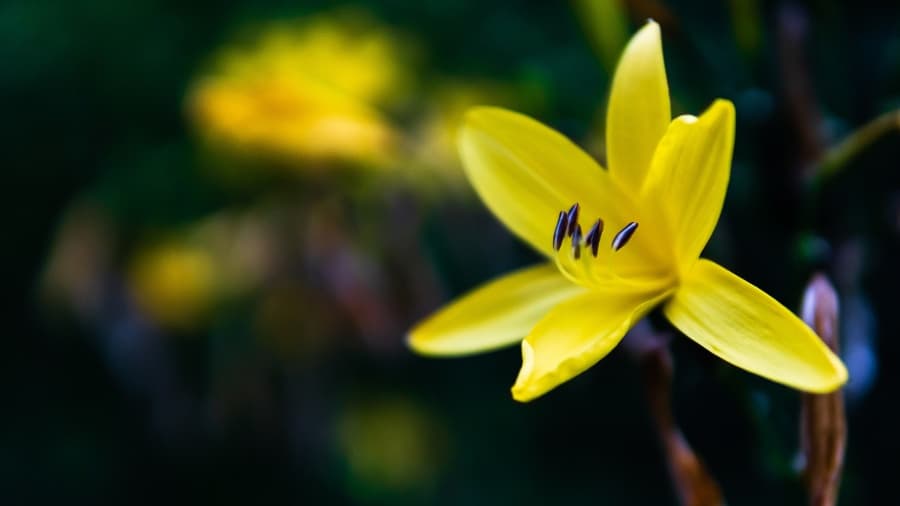
The Daylily’s 2,500-Year Journey: How China Turned a Poet’s Flower into a Kitchen Staple
The Chinese idiom “huánghuācài dōu liáng le,” literally “even the daylily dish has gone cold,” is a northern colloquial expression for someone who has arrived so late that the moment has passed and nothing can be retrieved. The phrase rolls off the tongue without a second thought. Yet the plant at its heart carries a history in Chinese literature and medicine so old and so layered that calling it a mere vegetable feels like an injustice.
In modern botanical classification, the daylily belongs to the genus Hemerocallis in the lily family. In classical Chinese, its most venerable name was xuāncǎo, written 萱草. The plant has been cultivated and documented in China for more than 2,500 years, and its earliest written record appears in the Book of Songs (Shijing), the oldest existing collection of Chinese poetry, compiled during the pre-Qin period. The poem “Bo Xi,” a wife’s lament for her husband away at war, contains the lines:
“Where can I find the herb of forgetting? I would plant it behind the northern hall.”
“The northern hall” was the rear of a traditional Chinese house, the quarters where the family’s mother lived. The herb of forgetting was the daylily: the wife, longing for her absent husband, imagines planting it outside her mother-in-law’s window so that the older woman’s grief might be eased.
The daylily as China’s flower of motherhood and medical herb
Before setting out on a long journey, a dutiful son would plant daylilies by his mother’s window; the golden blooms, it was believed, would lift her spirits and ease the ache of separation. That practice predates the Western carnation’s association with motherhood by well over a millennium. The plant came to be known as wàngyōucǎo, the “herb of forgetting sorrow,” and the part of the house where a mother dwelled acquired the poetic name “the hall of the daylily.”
SIGN UP FOR OUR FREE NEWSLETTER
You are now signed up for our newsletter
Check your email to complete sign up
Ji Kang, the leading philosopher of the Three Kingdoms period (220–280 CE), whose essay “On Nourishing Life” became one of the foundational texts of classical Chinese thought, wrote: “Mimosa blossoms dispel anger; daylily blossoms dissolve grief.” He was recording what his contemporaries treated as practical knowledge: that eating mimosa flowers could calm fury, and that eating daylilies could clear the mind and release anxiety. The passage anchored the daylily’s reputation in medical and philosophical discourse, lending it a weight that folk belief alone could not have sustained.
Tang dynasty concubines wore daylilies hoping to conceive sons
A folk belief dating back at least to the Western Jin period (265–316 CE) held that if a pregnant woman wore the flower, she would give birth to a son, earning the plant the name “son-welcoming herb.” In the Tang dynasty (618–907 CE), this claim entered the imperial palace as fashion. A collection of court anecdotes from the reign of Emperor Xuanzong (712–756 CE) records that the imperial palace grounds were planted extensively with daylilies. Concubines who had failed to produce an heir would gather the flower buds at the height of bloom and tuck them into their sashes or hair ornaments, hoping the plant’s legendary power would bring them the son they needed to secure their standing at court.
Outside the palace walls, a parallel history was unfolding. The Northern Wei agricultural encyclopedia Qimin Yaoshu, completed around the sixth century CE, documented techniques for cultivating daylilies, though the focus remained on garden planting rather than eating. By the Northern Song dynasty (960–1127 CE), the pharmacologist Su Song, in his Illustrated Classic of Materia Medica, recorded that the plant grew wild across the countryside and that people were already gathering its tender shoots and flower buds to eat as a vegetable, noting that the practice was excellent for the chest and diaphragm.
Li Shizhen’s 1578 compendium named the daylily a culinary ingredient
Li Shizhen, the Ming-dynasty physician and naturalist whose Compendium of Materia Medica, completed in 1578, remains the defining reference work of pre-modern Chinese medicine, catalogued the plant’s pharmacological actions across its stalk, flower, and root: the shoots aided digestion and cleared dampness from the body, a classical Chinese medical concept referring to the elimination of fluid retention and sluggishness; the roots treated urinary gravel and promoted the downward flow of water. For cooking, Li recorded that people in eastern China were picking the flower buds, drying them, and selling them under the name huánghuācài, “yellow flower vegetable.” A second name, jīnzhēncài, “golden needle vegetable,” also circulated widely, and it is under that name that dried daylily appears today in Chinese grocery stores and restaurant kitchens around the world.
By Xiao Guang, Vision Times