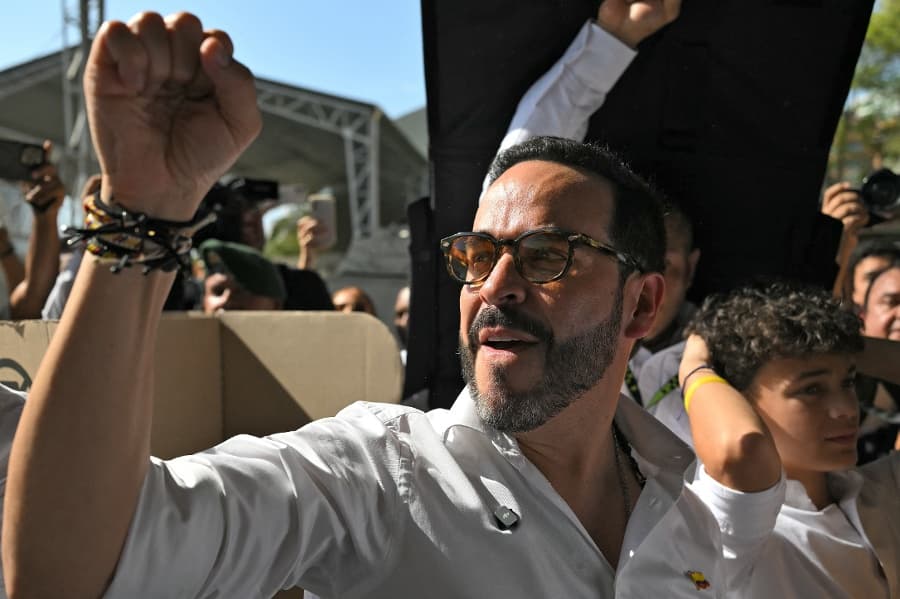
Colombia Presidential Election Heads to Runoff as Crime-Focused Candidate Takes Surprise Lead
According to a May 31 Associated Press report, the first round of Colombia’s presidential election results has been released. Political newcomer Aberaldo de la Espriella, who ran on a platform of “cracking down hard on crime,” unexpectedly took the lead and advanced to the second-round runoff. He will face Iván Cepeda, the candidate of the ruling coalition, in the decisive June vote.
The election is seen not only as a referendum on President Gustavo Petro’s governing approach, but also as a reflection of Latin America’s intensifying struggle between “peace negotiations” and “iron-fist law enforcement.”
First-round results announced; two camps advance to runoff
According to data released by Colombia’s electoral authority, with 99.98 percent of votes counted, De la Espriella received 44 percent of the vote, ahead of Cepeda’s 41 percent. Since neither candidate secured a majority, the two will proceed to a second-round runoff.
However, after the results were announced, Cepeda and the Petro administration immediately questioned the vote count process, the Associated Press reported. They claimed that hundreds of thousands of ballots may have been manipulated and hinted at foreign interference in the election, although no evidence has been presented so far.
Cepeda said he would not formally recognize the first-round results until the electoral commission completes its review.
SIGN UP FOR OUR FREE NEWSLETTER
You are now signed up for our newsletter
Check your email to complete sign up
“Only when the vote-counting commissions have fully clarified what happened will we comment on tonight’s results,” Cepeda said at a rally with supporters. However, he also acknowledged that the election is likely to proceed to a final runoff.
The Guardian noted that the results reflect a deeply divided Colombian society, with urban and rural voters holding sharply different views on national security, economic development, and the peace process. The second round is expected to be one of the most competitive presidential runoffs in recent years.
‘The Tiger’ surge reshapes race as crime dominates agenda
De la Espriella, a relatively non-establishment political figure, is nicknamed “El Tigre” (The Tiger) by supporters. He was not initially seen as a frontrunner, but his support rose rapidly as the election approached amid worsening domestic security conditions.
For much of the campaign, Cepeda had led in polls. He advocates continuing Petro’s “total peace” policy, which seeks to end violence through negotiations with guerrilla groups and armed criminal organizations.
However, the Associated Press noted that in recent years several armed groups in Colombia have expanded their influence during peace talks, leading to increased violence in some regions. Drone attacks, armed clashes, and political violence have become frequent, causing more voters to question the effectiveness of negotiation-based peace.
De la Espriella proposes a sharply different approach. He promises aggressive crackdowns on armed groups, the construction of 10 large prisons, and policies modeled after Salvadoran President Nayib Bukele’s hardline anti-gang strategy.
At a rally, Abelardo de la Espriella called for the United States and other democratic countries to observe and supervise the second-round runoff. He declared that he would lead the fight ahead and positioned himself as Colombia’s defender in the battle against what he called tyranny.
Petro’s four years in office face national verdict
Many analysts view this election as a nationwide judgment on Petro’s administration.
In 2022, Petro became Colombia’s first left-wing president, pledging to resolve decades of armed conflict through social reform and peace negotiations. He raised the minimum wage, expanded social welfare programs, and attempted talks with multiple armed groups.
However, the Financial Times previously noted that while some social policies gained grassroots support, deteriorating security and stalled reforms have gradually weakened public backing for the government.
In particular, nearly a decade after the 2016 historic peace agreement between the Colombian government and the Revolutionary Armed Forces of Colombia (FARC), many citizens had hoped the country would finally emerge from the shadow of civil conflict. Instead, reality has been less optimistic: some former rebel factions have reactivated, and violence in rural areas has risen again.
Just before the election, 39-year-old presidential candidate Miguel Uribe Turbay was shot and killed at a political rally, further intensifying public concern over security.
Despite this, Petro still retains steady support among some young voters, labor unions, and urban left-leaning groups.
Colombia at a crossroads
The election highlights deep divisions over the country’s future direction.
According to the Associated Press, Maria Eugenia, a 57-year-old tailor, said in an interview that she appreciates Petro’s efforts to improve the healthcare system, but worsening security ultimately led her to support De la Espriella.
“Of course, whenever you come down with a heavy hand, there’s always going to be debate. But some people are going to have to fall to clean up what needs to be cleaned up,” she said.
In contrast, 62-year-old sociologist Juan Acevedo holds the opposite view. He fears that heavy-handed repression could return Colombia to decades of relying on military solutions.
“We’re a country that has lived through 60 years of conflict,” Acevedo said. “The danger here is that we return to the times where everyone is saying that the only way to solve our problems is with bullets and more war.”
Reuters analysis suggests that regardless of who wins the presidency, Colombia will have a significant impact on Latin America. A Cepeda victory would signal that left-wing reform remains viable, while a De la Espriella win could indicate a regional shift toward more conservative, security-focused governance.
As the second round approaches, Colombian voters are choosing not just between two candidates, but between two fundamentally different models of governance: continuing peace through negotiation, or restoring order through a more forceful approach. For a country long shadowed by conflict, this runoff may shape its trajectory for years to come.