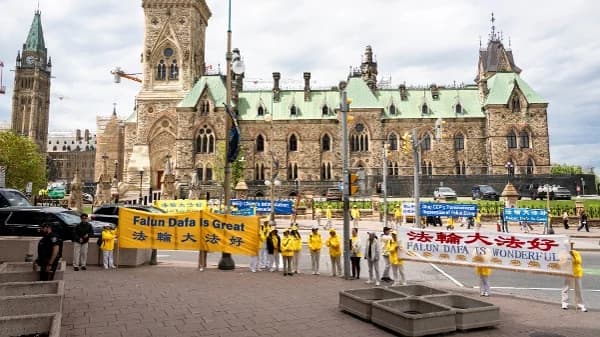
Protesters Urge Canada to Hold Firm on Human Rights as Wang Yi Visits Ottawa
OTTAWA, Canada — Chinese Foreign Minister Wang Yi returned to Ottawa on May 28-29 for his first visit to the country in more than a decade, meeting with Prime Minister Mark Carney and Foreign Minister Anita Anand amid growing debate over trade, security, and Canada’s relationship with Beijing.
During the visit, hundreds of Falun Gong practitioners and nearly 40 members of the Chinese Democracy Party’s Canadian Committee gathered on Parliament Hill to protest what they described as the Chinese Communist Party’s (CCP) ongoing human rights abuses and transnational repression.
The visit highlighted a broader debate unfolding in Canada over how to balance economic engagement with Beijing against concerns involving human rights, foreign interference, national security, and the erosion of democratic values.
Falun Dafa, also known as Falun Gong, is an ancient Chinese spiritual practice introduced to the public in 1992. Rooted in the principles of Truthfulness, Compassion, and Forbearance, the practice focuses on self-improvement via meditation exercises and moral cultivation. Despite being peaceful in nature, the CCP launched a brutal campaign to eradicate Falun Gong in July 1999.
Since then, thousands have perished at the hands of Chinese police, while many adherents still undergo routine monitoring, arbitrary travel bans, and arrests.
A changed relationship
SIGN UP FOR OUR FREE NEWSLETTER
You are now signed up for our newsletter
Check your email to complete sign up
Political commentator and popular YouTube host Gongzi Shen told Vision Times that Canada-China relations have changed dramatically since Wang’s last visit in 2016. During that trip, Wang drew international attention after sharply rebuking a Canadian reporter who questioned China’s human rights record. The exchange generated widespread criticism and became one of the defining moments of his earlier visit.
According to Gongzi Shen, relations deteriorated significantly following the arrest of Huawei executive Meng Wanzhou and China’s subsequent detention of Canadian citizens Michael Kovrig and Michael Spavor. “Canada’s perception of the CCP has changed enormously,” he said, arguing that public trust in Beijing has declined substantially over the past decade.
He suggested that Beijing now sees an opportunity to improve ties amid periodic tensions between Canada and the United States. “Seeing cracks in U.S.-Canada relations, they want to take advantage of that opening,” he said.
Trade promises and strategic concerns
Charles Burton, a senior fellow at the Sinopsis think tank and a former Canadian diplomat to China, said Wang’s visit reflects Beijing’s broader push to strengthen its influence in Canada’s foreign policy and promote what Chinese officials describe as a more “strategically independent” approach from Ottawa.
During meetings with Foreign Minister Anand, Chinese officials emphasized what they described as “strategic independence.” Some Canadian analysts interpret the phrase as an appeal for Ottawa to maintain greater distance from Washington on issues involving China.
Burton cautioned that Beijing often offers expanded market access while expecting political concessions in return. “The Chinese side makes demands of Canada in exchange for promises to maintain or expand access for Canadian products to the Chinese market,” he said. “But we have no guarantee that Beijing will fulfill those promises.”
Meanwhile, Anand has stated that Canada hopes to increase exports to China by a whopping 50 percent by 2030. Burton questioned whether potential economic gains would justify concessions in other areas. “I don’t see that the concessions made in non-trade areas, including security, sovereignty, and democratic values, can be justified by these potential benefits,” he said.
Other experts have warned that greater dependence on Chinese markets could leave Canada vulnerable to future economic pressure, particularly in sectors such as agriculture.
Concerns over law enforcement cooperation
Beyond trade, critics have raised concerns about a memorandum of understanding reportedly signed earlier this year involving cooperation between the Royal Canadian Mounted Police (RCMP) and China’s Ministry of Public Security. The contents of the agreement have not been publicly disclosed.
International human rights lawyer David Matas said Canada should be cautious when dealing with Chinese law enforcement agencies. “Canada should not cooperate with a country that lacks the rule of law and uses its criminal justice system to pursue political targets,” Matas said during a May 28 press conference hosted by the Falun Dafa Association of Canada.
He argued that China’s legal system remains under Communist Party control and that criminal charges are often used for political purposes.
Joel Etienne, legal counsel for the association, also questioned the agreement from a constitutional perspective. “But whenever China’s public security authorities are involved, we have no right to know what they are doing in Canada,” he said. “This clearly violates the Charter and creates two classes of citizens: those targeted by the CCP and those the CCP has no interest in. That is not the Canadian way of life.”
Transnational repression
Several speakers pointed to what they described as growing signs of transnational repression inside Canada. Earlier this year, six Shen Yun Performing Arts performances in Toronto were canceled after bomb threats were received by the venue, despite officials giving an all-clear. Organizers and activists called on federal authorities to fully investigate the incident.
Founded in 2006, Shen Yun Performing Arts is the world’s premier classical Chinese dance and music company, showcasing the beauty and splendor of traditional Chinese culture and art prior to the ravages of communism. The New York-based company currently boasts eight equally sized troupes that tour and perform across the world simultaneously, putting on a brand new production each year.
Yu Houqiang, chairman of the Chinese Democracy Party’s Canadian Committee, argued that the Canadian government should establish a dedicated task force to examine such cases. “Shen Yun performances were stopped because of bomb threats,” he said. “This is not simply a loss of freedom. It has led many people to feel that Canada is no longer the Canada it once was.”
According to a 2022 report by Safeguard Defenders, China has established at least 102 overseas police service stations in 53 countries, including several in Canada. Chinese authorities have denied that the facilities function as police stations.
Dean Baxendale, CEO of the China Democracy Foundation and a Canadian publisher, said he had personally received death threats after publishing books critical of the CCP. “These kinds of incidents happen every day,” he said, arguing that government protections remain insufficient.
A test for Ottawa
As Wang’s visit concluded, demonstrators continued to urge Canadian leaders not to sacrifice core values for economic opportunities. Gongzi Shen said Ottawa should approach any future engagement with Beijing from a position of principle.
“Canada must hold the line on democracy, human rights, and national security,” he said. “Those principles cannot be traded away simply to sell a few more tons of agricultural products.”
For many observers, Wang’s return to Ottawa represents more than a diplomatic visit. It has become a test of how Canada intends to navigate one of its most complex foreign policy relationships while preserving its own democratic institutions and values.