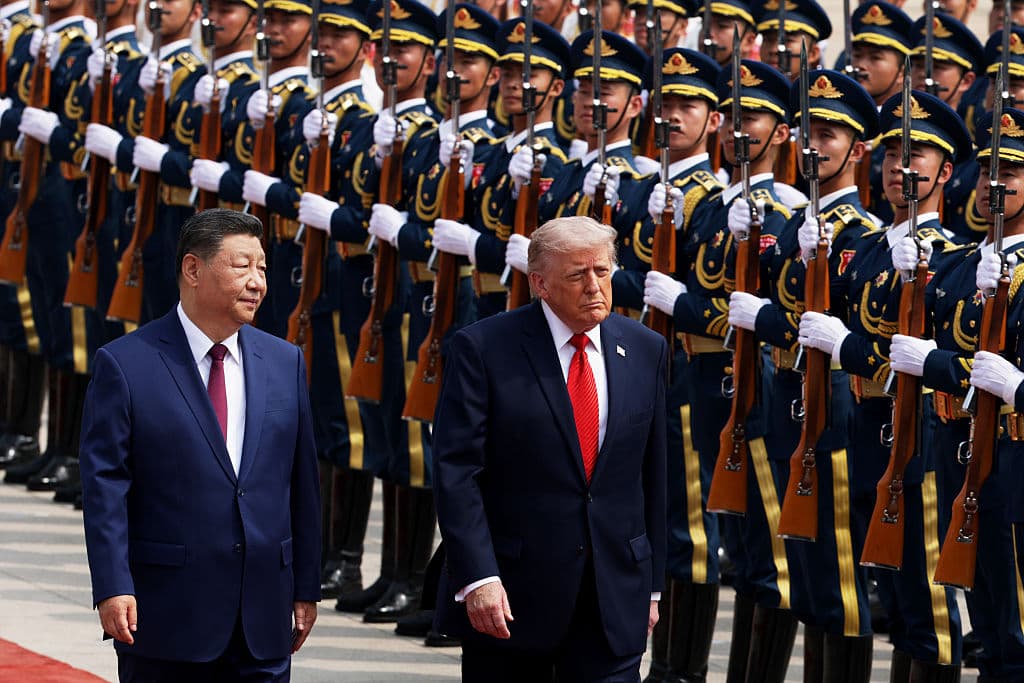
Xi Clashes With Trump Over Japan’s Military Expansion During Beijing Summit
Chinese leader Xi Jinping reportedly clashed with U.S. President Donald Trump during their recent summit in Beijing over Japan’s expanding military posture, highlighting deepening tensions across the Indo-Pacific. According to a report by Japan Times citing information first revealed by Financial Times, Xi became visibly agitated while discussing what Beijing views as Japan’s “remilitarization.”
Multiple sources familiar with the talks told the Financial Times that Xi directly criticized Japanese Prime Minister Sanae Takaichi and Taiwanese President Lai Ching-te, accusing both leaders of undermining regional peace and stability as tensions continue rising across the Indo-Pacific.
The exchange reportedly became one of the most tense moments during the two-day summit and surprised some American officials, as Japan’s military expansion had not previously been considered a central issue in high-level U.S.-China negotiations.
RELATED: Iran Secretly Acquired Chinese Satellite Equipment Via UAE Network: Report
Xi warns against Japan’s ‘remilitarization’
According to Japan’s Yomiuri Shimbun, Xi urged Trump not to support either Takaichi or Lai during the meeting and warned that Japan’s recent military buildup had triggered serious concern in Beijing. Trump reportedly pushed back against Xi’s criticism and defended Takaichi directly, telling Xi that the Japanese leader was not “the kind of leader who should be blamed.”
SIGN UP FOR OUR FREE NEWSLETTER
You are now signed up for our newsletter
Check your email to complete sign up
Trump has publicly praised Takaichi in the past, once describing her as “a delight.” Sources cited by the Financial Times also said Trump argued that Japan’s military strengthening is primarily aimed at deterring North Korea’s growing nuclear threat rather than confronting China directly.
Still, Japan’s recent security reforms have become a major source of anxiety for Beijing. Since returning to power earlier this year, Takaichi’s government has accelerated efforts to expand Japan’s defense capabilities, including increasing military spending and advancing constitutional reforms that could loosen restrictions on the activities of the Japan Self-Defense Forces.
Japan expands missile deployments near Taiwan
Japan has increasingly strengthened military deployments across its southwestern islands as part of a broader deterrence strategy focused on China. In April, Japan reportedly deployed upgraded long-range anti-ship missiles to its western command region. The missiles are believed to have a range of roughly 1,000 kilometers, potentially allowing them to reach portions of China’s eastern coastline.
Tokyo is also planning to deploy surface-to-air missile systems on Yonaguni Island, Japan’s westernmost inhabited island located near Taiwan, by 2031. Meanwhile, China’s Foreign Ministry publicly criticized Japan’s military spending increases earlier this month, pointing to a reported 9.7 percent rise in Japan’s defense budget last year, along with a sharp increase in weapons imports.
The Center for Strategic & International Studies (CSIS) previously reported that Japan is gradually developing what officials call “counterstrike capability,” a move widely viewed as one of the country’s most significant defense policy shifts since World War II.
Taiwan central to regional tensions
Taiwan has become an increasingly sensitive issue in relations between China and Japan. Tensions escalated after Takaichi suggested last year that a conflict involving Taiwan could potentially trigger constitutional provisions allowing Japan to intervene in regional contingencies.
Beijing has reacted strongly to such comments as Chinese military activity around Taiwan continues to intensify. According to statistics from Japan’s Defense Ministry, the scale of Chinese military operations near Taiwan has increased massively over the past five years. Despite having its own de facto government, Communist China views Taiwan as a “breakaway province” that must be reclaimed.
Because Japan’s Okinawa island chain lies geographically close to Taiwan, many Japanese security officials increasingly fear that a Taiwan Strait conflict could quickly spill into Japanese territory. The Japan Times reported that growing numbers of Japanese citizens now view China, rather than North Korea, as the country’s primary security threat.
A Japanese government poll released earlier this year found that 68 percent of respondents considered China a greater threat than North Korea, marking the first time China topped the list.
East China Sea disputes continue to simmer
Beyond Taiwan, tensions between China and Japan continue to rise around the disputed Senkaku Islands, known in China as the Diaoyu Islands, in the East China Sea. The islands are currently administered by Japan but claimed by China, and confrontations involving coast guard and government vessels from both countries have become increasingly frequent.
Japanese authorities have at times reportedly advised local fishermen to avoid operating near the disputed waters to reduce the risk of escalation. At the same time, regional attention remains focused on Washington’s evolving security posture in Asia.
Despite Trump’s broader “America First” rhetoric, Washington has continued strengthening security cooperation with allies such as Japan and the Philippines as part of its strategy to counter China’s growing influence in the Indo-Pacific, according to reporting by The Wall Street Journal.
Analysts say that growing U.S.-Japan coordination on regional security issues remains one of Beijing’s deepest strategic concerns as tensions across the Indo-Pacific continue to escalate.