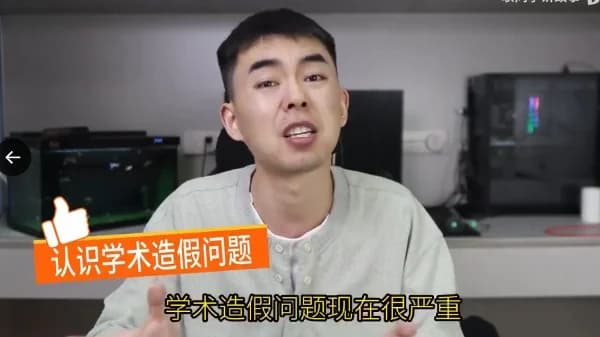
China’s Academic World Rocked as Whistleblower Exposes Research Fraud, Plagiarism
China’s academic world has been thrown into turmoil after a former doctoral student launched a series of high-profile allegations accusing some of the country’s most prominent scholars of suspected research misconduct and data manipulation.
The whistleblower, known online as “Geng Tongxue” (“Student Geng”), has rapidly become one of the most closely-watched figures on Chinese social media after publicly challenging elite academics tied to China’s top universities and state-backed research programs.
RELATED: Propaganda in the AI Era: New Study Warns Biased Training Data Shapes AI Answers
According to Chinese media reports and social media accounts, Geng Hongwei, a former PhD student at Beihang University’s School of Biological Science and Medical Engineering, claims he was effectively pushed out of academia after refusing to participate in what he described as questionable research practices, including data manipulation and improper authorship arrangements.
近日,网名“耿同学讲故事”的博主在党国走红。他40天内连续公开质疑多名高校顶级学者论文存在数据异常、图片重复、疑似造假等问题,而被点名的全是党国学术圈重量级人物。耿同学本人曾是博士生。据其自述,当年因“不愿配合学术造假”,最终选择肄业离开。 pic.twitter.com/9y3LiKfkf1— Mike (@Mike781819) May 25, 2026
近日,网名“耿同学讲故事”的博主在党国走红。他40天内连续公开质疑多名高校顶级学者论文存在数据异常、图片重复、疑似造假等问题,而被点名的全是党国学术圈重量级人物。耿同学本人曾是博士生。据其自述,当年因“不愿配合学术造假”,最终选择肄业离开。 pic.twitter.com/9y3LiKfkf1
Chinese outlet Sina reported that Geng abandoned five years of doctoral studies after allegedly facing long-term pressure, delayed graduation, and conflicts with his adviser. Following his departure from academia, Geng reinvented himself as an academic fraud investigator.
SIGN UP FOR OUR FREE NEWSLETTER
You are now signed up for our newsletter
Check your email to complete sign up
Over the past 40 days, he has publicly accused several influential scientists and university officials of suspected irregularities involving published papers, statistical anomalies, and possible research misconduct.
Elite scholars thrust into controversy
Many of the figures targeted by Geng are associated with some of China’s most prestigious academic honors and funding programs. Among those publicly questioned were scholars linked to institutions including Tongji University, Nankai University, Sun Yat-sen University, and Shanghai University.
Several held elite titles such as “Changjiang Scholar” or recipients of China’s prestigious National Science Fund for Distinguished Young Scholars.
One of the most closely watched cases involved Wang Ping, dean of Tongji University’s School of Life Sciences and Technology. Chinese media reports said Wang was removed from his position earlier this month, while the lead author of one disputed paper was reportedly dismissed.
Chinese social media users have widely circulated estimates claiming that scholars questioned by Geng collectively oversaw or received more than 14.5 billion yuan (roughly $2 billion USD) in state research funding, though the exact figure could not be independently verified.
‘A direct clash with academic rules’
The controversy has resonated strongly online partly because many Chinese students and researchers say Geng’s story reflects deeper frustrations inside China’s highly competitive academic system. According to reports circulating online, Geng said he mainly files complaints through three channels:research funding agencies, university administrations, and academic journal editors.
“Professors receive funding from management departments,” Geng said in one video. “If the party receiving the money deceives the party providing the money, then the funding side naturally has the right to punish them.”
As his online following grew, Geng also acknowledged increasing pressure and personal risk. “The resistance recently has been the greatest,” he said, adding that he now informs family members of his whereabouts whenever he leaves home.
A widely-circulated article reposted on X portrayed Geng as an unlikely anti-fraud crusader who originally hoped only to earn his doctorate, return to his hometown, teach at a vocational college, and build a quiet life with his partner.
就社會道義上講,他現在的“復仇”遠比一個狗屁的博士帽子重要。他的被迫以身犯險,其實是在替天行道。 https://t.co/ZqW2zLfnOR— 篤行者🗽🏛 (@Duxingzhe1776) May 20, 2026
就社會道義上講,他現在的“復仇”遠比一個狗屁的博士帽子重要。他的被迫以身犯險,其實是在替天行道。 https://t.co/ZqW2zLfnOR
Instead, supporters say, his forced departure from academia transformed him into one of the Chinese research world’s most feared critics. “He was not persuaded to leave gently or allowed to graduate with dignity,” the article claimed. “He was forcibly pushed off the academic track.”
AI tools and social media fuel new scrutiny
Geng’s rise also reflects how AI-powered analysis tools and social media platforms are changing the landscape of academic oversight in China. According to online supporters, Geng now uses statistical analysis, image comparisons, and AI-assisted plagiarism tools to examine published scientific papers for irregularities.
With more than 1.8 million followers across Chinese video platforms such as Douyin and Bilibili, his investigations have attracted massive public attention. Supporters describe him as exposing systemic flaws inside China’s research system, while critics warn that online accusations alone do not necessarily prove misconduct.
Nevertheless, the controversy has triggered broader debate about publication pressure, funding incentives, and the intense competition surrounding elite academic titles in China. Many online commenters argued that the scandal reflects structural problems rather than isolated cases. “If the system had simply allowed him to graduate, perhaps everything would have ended quietly,” one widely-shared comment read. “But instead, the system created someone who no longer fears losing anything.”
Another commenter wrote, “Don’t push honest people into desperation. You may destroy their graduation dream, but unleash someone capable of shaking the entire system.”
Others praised Geng for challenging powerful institutions long viewed as untouchable inside China’s tightly-controlled academic hierarchy.