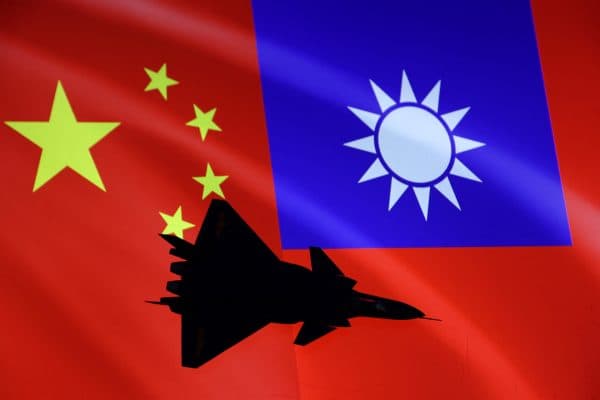
US Delay of $14 Billion Taiwan Arms Package Raises Questions Over America’s Defense Capacity and China Strategy
JuJust a week after the Trump-Xi summit in Beijing, the U.S. paused a $14 billion arms sale to Taiwan to ensure it had sufficient weapons stockpiles for the Iran war, acting Navy Secretary Hung Cao told the U.S. Senate on May 21.
Taiwan stands as a core issue in U.S.–China talks, as Beijing sees Taiwan, a democratically governed island off the mainland Chinese coast, as part of its sovereign territory and demands its “reunification” by any means necessary.
While the U.S. does not formally recognize Taiwan’s statehood, it remains an important ally, selling Taiwan high-tech weapons and equipment that would be essential in the event of an invasion.
Think tanks and strategic analysts are divided over the causes and implications of the recent sales delay. Some believe it reflects genuine concerns about dwindling U.S. stockpiles and defense-industrial constraints amid the Iran conflict, while others argue the move is unrelated to the war and instead tied to broader geopolitical calculations, including Trump’s negotiations with the Chinese leadership.
“Right now we’re doing a pause in order to make sure we have the munitions we need for Epic Fury – which we have plenty [of],” Cao told a Senate hearing on Thursday, May 21. Epic Fury is the operational name for the joint U.S.-Israel military campaign in Iran.
SIGN UP FOR OUR FREE NEWSLETTER
You are now signed up for our newsletter
Check your email to complete sign up
“We’re just making sure we have everything, but then the foreign military sales will continue when the administration deems necessary.”
Two days after the pause was announced, Taiwan National Security Council Secretary-General Joseph Wu wrote on X that Communist China had deployed more than 100 ships along the first island chain immediately after the Trump-Xi summit. The first island chain stretches from Japan to Taiwan and the Philippines.
Diminished inventories
Some analysts agree with Cao’s assertion that U.S. reluctance to supply weapons to Taiwan is related to a munitions shortage in the Middle Eastern conflict.
The issue was being debated even before the Iran ceasefire and prior to the suspension of arms sales to Taiwan. In an April 21 analysis, Marc F. Cancian and Chris H. Park of the Center for Strategic and International Studies (CSIS) said the U.S. still had enough of seven key munitions to sustain operations against Iran, but warned depleted inventories could affect weapons supplies to allies.
“Rebuilding to prewar levels for the seven munitions will take from one to four years as missiles in the pipeline are delivered. These missiles will also be critical for a potential Western Pacific conflict,” Cancian and Park said, adding that U.S. stockpiles were already considered insufficient for a conflict with a peer adversary before Epic Fury began on Feb. 28.
They said the shortfall had become more severe following the conflict and warned the U.S. would need years to rebuild inventories needed for a possible conflict with China.
“Diminished inventories will also affect the U.S. supply of Patriot, Terminal High Altitude Area Defenses (THAADs), and Precision Strike Missiles (PrSMs) to Ukraine and other allies and partners that use them,” the analysts said.
The Pentagon recently announced a $4.76 billion contract to accelerate production of Patriot surface-to-air missiles after firing roughly 1,700 of them in just five weeks.
Part of the reason for the rapid usage of interceptors is the proliferation of massed drones in modern warfare. Used in the role of missiles, these weapons are cheaply built and
In a May 18 analysis for the Foreign Policy Research Institute (FPRI), Macdonald Amoah, Morgan D. Bazilian and Lt. Col. Jahara Matisek said the figures highlighted a structural problem within the U.S. defense industry. The U.S. produces around 600 Patriot missiles annually, meaning it would take at least three years to replace the number used in just over a month.
“The United States can expend advanced precision-guided munitions in weeks, while the defense-industrial base takes years to replace them,” Amoah, Bazilian and Matisek said. “Time-money mismatches are not a budget glitch; it is a structural crisis that we describe as the ‘Iron Triangle of the Defense-Industrial Base.’”
The analysts described the “Iron Triangle” as a persistent tension between time, production capacity and cost. They argued the U.S. defense manufacturing system is struggling to keep pace with wartime demand and increasingly relies on emergency authorities to accelerate weapons deliveries.
“The Pentagon’s use of emergency authorities to accelerate arms sales is not a sign of strength; it is a confession of weakness,” they said.
Cost of defending Taiwan has increased
Although Washington’s policy of strategic ambiguity toward Taiwan remains unchanged, analysts say the cost of defending the island has risen sharply in recent years, adding pressure on the U.S. defense manufacturing ecosystem.
Jennifer Kavanagh, a Brookings Institution expert, wrote in a March 20 paper that the U.S. military-industrial base would face mounting pressure if Washington had to sustain conflicts in the Middle East while simultaneously deterring China in the Indo-Pacific.
Taipei has also linked U.S. arms sales to broader deterrence efforts in the region. Responding to Trump’s earlier remarks expressing uncertainty about new arms sales to Taiwan, Republic of China President Lai Ching-te’s spokesperson Karen Kuo said the transfers were tied directly to regional stability.
The ROC is Taiwan’s official name. Mainland China is governed as the People’s Republic of China (PRC).
“Furthermore, military sales between Taiwan and the U.S. are not only a reflection of the U.S. security commitment to Taiwan as stipulated in the Taiwan Relations Act, but also serve as a mutual deterrence against regional threats,” Kuo said in a statement quoted by Reuters.
Kavanagh argued, however, that rising military costs have altered the logic behind that deterrence framework.
“At the time, in 1979, the cost of any U.S. commitment to Taiwan was low. U.S. military dominance in the Taiwan Strait was largely assured, and the U.S. ability to deter and defeat any coercive threat to Taiwan at a sustainable price seemed nearly certain,” she wrote.
She said those conditions no longer exist. The PRC’s rapid military modernization in recent decades has shifted the balance of power across the Taiwan Strait and significantly increased the potential costs of U.S. intervention.
“A war over Taiwan today would be expensive and deadly and would carry the potential for nuclear escalation, even if the United States prevailed,” Kavanagh said.
In that context, she argued Washington should restructure its regional posture and replace strategic ambiguity with “an explicit policy of nonintervention.”
Delay unrelated to Iran?
Some analysts and reports argue the suspension of Taiwan arms sales is unrelated to the Iran conflict, noting that weapons production and delivery timelines already stretch over several years.
“These sales take years to process and are unrelated to Operation Epic Fury,” an unnamed source told Reuters in a May 23 report.
“The United States military has more than enough munitions, ammo, and stockpiles to serve all of President Trump’s strategic goals and beyond.”
A report in The Guardian similarly argued that even if the Taiwan arms package had not been paused, deliveries would still take years, making it unlikely that the Iran conflict was the main reason behind the decision.
Rupert Hammond-Chambers, president of the U.S.-Taiwan Business Council and senior adviser at Bower Group Asia, told The Guardian the pause “makes no sense.”
“If he sends those congressional notifications by the end of June, you’re talking about another six to 12 months before the contract is signed, and then the clock starts on delivery. So we’re really into the 2030s [by the time Taiwan’s weapons are delivered],” he said in an article published Wednesday, May 27.
Hammond-Chambers said doubts about U.S. support for Taiwan would largely disappear if Trump approved the sales “in the next four to six weeks.”
However, he warned Taiwan would be left in a “terrible position” if the delay extended into autumn — around the time Trump is expected to host Xi at the White House, ahead of the Asia-Pacific Economic Cooperation (APEC) summit in China on Nov. 18-19 and the G20 summit in Miami in December.
Reliance on critical imports from China
Observers have also pointed to the U.S. defense industry’s dependence on imported critical materials, particularly from China, as another factor affecting arms production and military readiness.
This dependence compounds existing challenges tied to shrinking stockpiles, rising global demand and slow defense manufacturing capacity, reinforcing concerns that the U.S. may be unprepared for a prolonged conflict over Taiwan.
According to a September 2024 U.S. Government Accountability Office report titled “Critical Materials: Action Needed to Implement Requirements That Reduce Supply Chain Risks,” more than 95 percent of critical minerals consumed by the U.S. are imported, with roughly three-quarters sourced from the PRC between 2012 and 2022.
“The Department of Defense (DOD) has assessed there would be a high potential for harm to national security in the event of a supply chain disruption,” the report said.
“Most of these materials are mined and processed in China, which makes DOD’s weapon system programs vulnerable to supply chain disruptions by an adversary nation.”
Because Beijing dominates global processing of many critical minerals used in advanced weapons systems, analysts say some U.S. arms exported to Taiwan likely rely on mainland Chinese-sourced materials.
A January 20 report by the Washington-based Heritage Foundation, titled “Tidalwave,” warned the U.S. lacks the surge production capacity needed for a prolonged Taiwan conflict.
The report linked U.S. ammunition production constraints to reliance on concentrated foreign suppliers for roughly 10 non-substitutable materials.
“This dependency on highly concentrated foreign suppliers — principally the [PRC] for minerals and precursors, and Taiwan for microelectronics — grants the PRC direct leverage via export controls, extends import lead times to six to 12 plus months, and exposes the U.S. defense supply chain to deliberate disruption and geopolitical coercion.”
Analysts said this dependence on Beijing for critical minerals not only creates strategic vulnerabilities for the U.S. defense industry, but could also affect future weapons supplies to Taiwan.