The Fiction That Predicted The Titanic: Coincidence Or Warning?
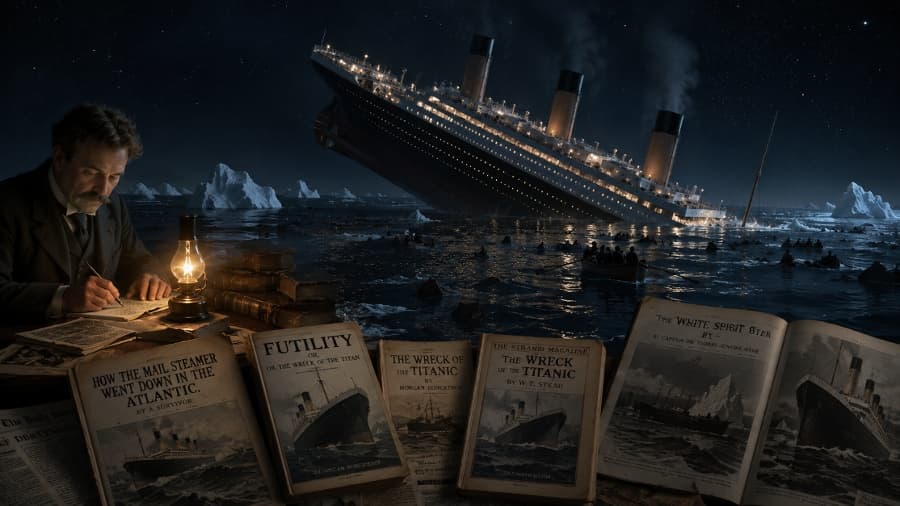
In April 1912, the “unsinkable” Titanic struck an iceberg in the North Atlantic and sank, sending more than 1,500 people to their deaths in the freezing waters. The disaster not only became one of the most famous tragedies of the 20th century, but also left behind a series of eerie coincidences that still send chills down people’s spines today. Long before the real tragedy occurred, stories about giant ocean liners hitting icebergs, carrying too few lifeboats, and causing mass drownings had already appeared multiple times in novels and short stories. The most widely known of these was a work published in 1886 by British journalist and author William Thomas Stead titled How the Mail Steamer Went Down in Mid Atlantic, by a Survivor.
In the story, an ocean liner traveling from Liverpool to New York collides with another vessel at sea. Because the ship does not carry enough lifeboats, many passengers lose their lives. Stead emphasized in the story that if large passenger ships continued sailing without sufficient lifeboats, such a catastrophe was inevitable. Twenty-six years later, those words became reality. Even more unsettling, when the Titanic embarked on its maiden voyage in 1912, Stead himself was aboard the ship.
According to later accounts, Stead had been invited by U.S. President William Howard Taft to attend a peace conference in America. On his final night aboard the Titanic, he reportedly entertained fellow passengers with suspenseful stories, including one involving a “cursed mummy.” After the iceberg collision, survivors said Stead helped women and children board lifeboats and even gave his own life jacket to someone else. He later disappeared into the freezing sea, and his body was never recovered.
‘From the Old World to the New’
In addition to his 1886 story, Stead also wrote another iceberg-related novel in 1892 titled From the Old World to the New. The story describes the White Star Line ship Majestic rescuing survivors from another vessel that had struck an iceberg. Looking back years later, many people felt these plot details seemed almost like a glimpse into fate itself.
Another work that made the idea of a “Titanic prophecy” famous was American author Morgan Robertson’s 1898 novel Futility, or the Wreck of the Titan. The story centers on a massive ocean liner named the Titan, described as “unsinkable.” The enormous ship sails across the North Atlantic but ultimately strikes an iceberg in April and sinks. The novel also notes that the vessel carries far too few lifeboats, resulting in heavy loss of life.
SIGN UP FOR OUR FREE NEWSLETTER
You are now signed up for our newsletter
Check your email to complete sign up
What makes the story even stranger is how closely the fictional Titan resembled the real Titanic. Its size, speed, passenger capacity, and even the speed at which it hit the iceberg were remarkably similar to the actual ship. Because of these uncanny parallels, the novel has long been regarded as one of history’s most famous examples of an apparent “disaster prediction.”
Shortly before the Titanic’s actual maiden voyage, another unsettling story quietly appeared. In 1912, author Thornton Jenkins Hains published a short story under a pen name titled The White Ghost of Disaster. It described an 800-foot passenger liner traveling across the North Atlantic at 22.5 knots before colliding with an iceberg and sinking. Due to a shortage of lifeboats, massive casualties followed. While the story was still sitting on magazine stands, the real Titanic—882 feet long—struck an iceberg at a similar speed in real life.
In addition, in 1908, author M. P. Shiel wrote The Lost Vessel, which directly used the name “Titanic” and portrayed it as the world’s largest and fastest passenger ship at the time. Although the ship in that story did not sink, readers looking back years later found the similarities astonishing.
Some believe these works were simply logical predictions based on the rapid development of giant ocean liners at the time. In the early 20th century, luxury passenger ships often did suffer from insufficient lifeboat capacity, and the iceberg routes of the North Atlantic were already well known as dangerous waters. Others, however, cannot ignore the coincidences that seem almost too close to reality. Especially in the case of Stead—the man who first wrote about such a shipwreck and ultimately died in the Titanic disaster himself—the line between “prophecy” and “coincidence” became even more blurred.
By Ying Tiao, Vision Times